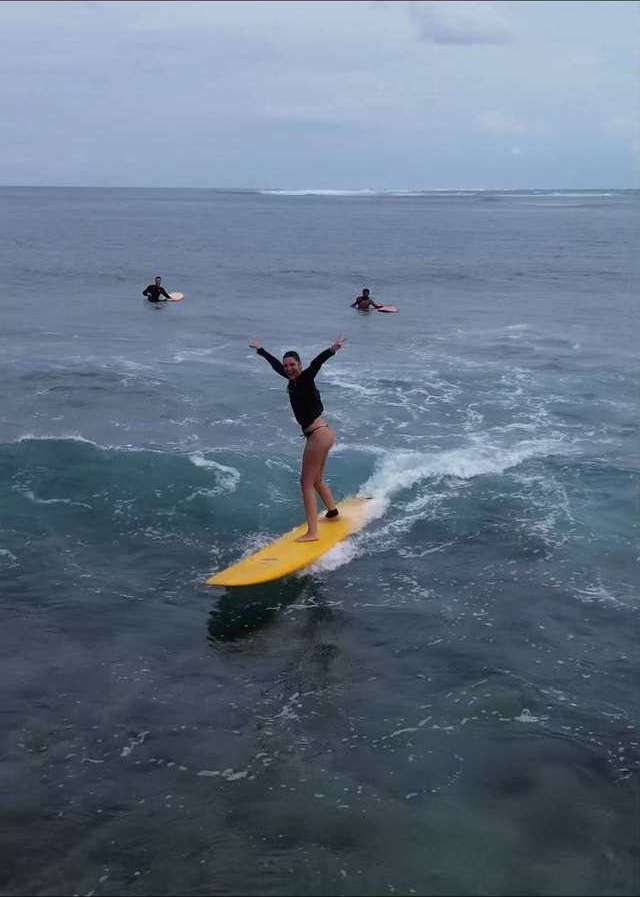
The short answer: there is no month you cannot learn in
The easiest time to learn to surf in Siargao is April and May, and again June to September. In our view April and May are the best choice for a first lesson. Waves are small in those months and the water is warm. On roughly half the days from July to September, the south-westerly wind blows offshore on the Cloud 9 side of the island, and the wave faces are clean. The biggest waves arrive from December to February. The famous season, late September to November, belongs mostly to experienced surfers who come for the powerful reef waves.
There is somewhere to learn in every month of the year. Each morning our coach picks a spot by level, tide and wind, and the spot changes with the season. Further down you will find which spot suits which month. Next to each figure we say where it comes from, and we flag the ones that are our own calculation or inference.
If you want the wider picture of surfing on the island, start with the guide to surfing in Siargao. This page is only about the calendar.
Why the famous season is not the season of the biggest waves
Two seasonal winds decide almost everything. The amihan, the north-east monsoon, began last year on 27 October 2025, as announced by PAGASA, the Philippine weather service, and ended on 23 March 2026, according to SunStar’s report of the PAGASA declaration. The habagat, the south-west monsoon, began on 30 May 2026 according to a PAGASA announcement. On 5 October 2026 PAGASA announced that it had ended, per GMA News, and the same report expects the amihan to start towards the end of October.
Wind decides how a wave looks, and you can read the link from the direction each spot faces. According to our spots data, the file that feeds the surf forecast on the site, Cloud 9 faces 60 degrees, north-east to east, and its swell window is 340 to 150 degrees. A south-westerly wind comes from behind the island and the reef, so it blows offshore and smooths the wave face. A north-easterly wind comes in from the sea and roughens it. At Guiwan, which faces south (175 degrees), the story is reversed: the winter north-easterly is offshore there. On the spots page you can see the season and level of each one.
Now for size. By our own calculation from ERA5 data via Open-Meteo for 2021 to 2025, the median daily maximum wave height at an open-ocean point off the east coast is largest in January (2.5 metres), February (2.3) and December (2.2), and smallest from June to August (0.9). In October the median is 1.4, and in November 1.6. Read these numbers with care: the model cell is about 50 kilometres across and the point is in open water, so they show the seasonal pattern; they cannot tell you the wave height on the reef.
Wind is the other half. By the same calculation of ours, in January and February the dominant wind is north-easterly to easterly on 93 percent of days. In July it is south-westerly to westerly on about half the days (55 percent). In October the two directions are almost level, 33 percent north-east and 34 percent south-west, and in November the north-east is back at 78 percent. This is our calculation on a coarse grid, so read it for the trend rather than the exact percentage.
That clears up what “the season” means. In late September the south-westerly still blows offshore on about half the days, and in October the sea has already grown to a medium size while that wind still blows on some days. In November the north-easterly returns, but the sea is still well short of winter size, and in some years a swell from distant storms in the Pacific joins in. Those storms do not show up in monthly averages, so this part is our physical explanation, not something we measured. From December to February you get more size and less order.
A whole year in one table: 12 months
The table combines PAGASA data, our spots data and our own calculations. Rainfall is a long-term PAGASA average for Surigao del Norte, the province Siargao belongs to. The PAGASA table does not state units, presumably millimetres, and the figure covers the province as a whole rather than the island itself.
| Months | Open-ocean size (our calculation) | Wind on the Cloud 9 coast | Rain (PAGASA) | Crowds | Where to start |
|---|---|---|---|---|---|
| December to February | The biggest of the year | North-easterly, from the sea. At Guiwan it is offshore | The wettest months of the year, together with November: 609.4 in January, 585.2 in December, 446.4 in February | Peak around Christmas | Ocean 9, Jacking Horse, and Guiwan if you have already stood on a board |
| March | Dropping | North-easterly until the end of the amihan | 326.0 | Holy Week, 25 to 27 March 2027 | Ocean 9 and Jacking Horse |
| April and May | Small | North-easterly on most days, and in May on only about half | 219.1 in April, 139.6 in May | Relatively quiet | Jacking Horse, and Daku when there is swell |
| June to September | The smallest | From July south-westerly, offshore, on about half the days | 133.9 in August, the lowest of the year, and still not dry | Relatively quiet | Jacking Horse, very small in these months |
| October | Medium | Switching: almost level between north-east and south-west | 240.7 | Building towards the end of the month | Ocean 9 opens up, Jacking Horse |
| November | Medium or bigger | North-easterly returns | 467.3 | Philippines Pro, 31 October to 10 November 2026 | Ocean 9, Jacking Horse and Daku |
The table gives no wave height for a specific day, and that is deliberate: the waves on a given day can only be known from a forecast a few days ahead. How to read one is explained in the guide to reading the surf forecast.
June to September: the smallest, calmest waves of the year
This is when the habagat blows, and according to our spots data the south-westerly is offshore on the Cloud 9 coast. By our calculation the open ocean is smaller in these months than at any other time of year, and the water, by our calculation from NOAA satellite data, is at its warmest. Jacking Horse, a soft right over reef that feels like a beach break, gets very small between June and September, sometimes so small that you need patience. For someone taking first steps on a board that is enough: on a small, soft wave you can feel the wave push the board, and stand up on it.
The downside is that there are fewer spots to choose from. Salvacion is flat from June to August, Stimpy’s is flat from roughly late May to late August, and Ocean 9 works from October to March. That leaves mainly Jacking Horse. The full list of places to learn is in the guide to beginner spots. July to October is also the peak of typhoon season across the whole Philippines according to PAGASA, so keep an eye on the forecast in the week before you arrive.
October and November: the transition months and the peak
October is when the wind changes over. The habagat is finished, the amihan has not settled in yet, and in the meantime the sea starts to grow. Ocean 9, a sheltered north-facing bay, opens for the season and is one of the easier places for a first lesson. Cloud 9 and Tuason peak from late September to November, and Pacifico, in the north of the island, from October to December. All of them are spots for experienced surfers.
Since July 2025 there have been no beginner lessons at Cloud 9. The rule was reported on 15 and 16 July 2025 by several international surf outlets. As reported, beginner lessons are not allowed there, and shops will not rent a board to a beginner without an instructor. We could not find out who set the rule, so we give only the wording as reported. It applies to Cloud 9 only.
From 31 October to 10 November 2026, Cloud 9 hosts the Philippines Pro, a stop on the WSL Championship Tour, according to Daily Tribune in July 2026. The same report says the event was upgraded from a lower tier of the qualifying series to the senior tour for the 2026 and 2027 seasons. In 2024 the Siargao International Surfing Cup ran from 26 October to 4 November, according to a WSL announcement. It is a great event to watch, but expect the island to be full on those days.
Here is the opinion that costs us money. For a first lesson, do not aim for the peak of late October, November and Christmas. Those are the weeks when we, and every other business on the island, earn the most. Accommodation, boats and flights fill up early and prices on the island rise, and the water is at its most crowded too. The late October and November waves mostly serve advanced surfers at Cloud 9, and beginners cannot learn there anyway. If your week falls on the contest you can enjoy watching it, but a trip whose whole purpose is a first lesson should not be planned around it. For a first lesson it is better to come in April and May, or June to September, when the waves are smaller and the lineup is less crowded.
December to February: big swell, onshore wind and rain
In these months the open ocean is at its biggest, by our calculation. On the Cloud 9 coast the north-easterly comes in from the sea, so the waves are big and less tidy. Some spots do work in winter: Guiwan, which faces south, works in winter when the wind is north-easterly, and Salvacion is a favourite winter spot. Neither suits a first lesson. Guiwan has hidden rocks in shallow water, and it suits people who have already stood on a board a few times. Details are on the spot page.
If you arrive in winter and are starting from zero, you will find sheltered Ocean 9 and Jacking Horse, which works all year. And there is rain: by the PAGASA table January is the wettest month of the year (609.4), followed by December (585.2). Rain on its own usually does not cancel a lesson. In the morning the coach looks at the wind, the tide and the size of the waves.
The holiday crowds usually start in mid-December. The Philippine Department of Tourism counted 32,742 tourists in Siargao during the 2025 Christmas holiday break, according to Daily Tribune in January 2026. The report does not give dates.
The peak of typhoon season ends in October, but a storm can still arrive after it: on 16 December 2021, at around 1:30 pm, Typhoon Odette made landfall on Siargao, with winds of up to 195 km/h near the centre, according to a PAGASA update published that day by Philstar.
March to May: warm, relaxed, and one busy week
According to SunStar, PAGASA declared the end of the amihan on 23 March 2026, and the report’s headline paired that with the start of the warm, dry season. The word “dry” is an overstatement: in the PAGASA table even May, at 139.6, is far from dry. In April and May the sea is already small and the water is warming up, and outside Holy Week the crowds ease off too. In our view April and May are the best time for a first lesson: the waves are already small, but usually not too small, as they sometimes are from June to September. At Jacking Horse, and at Daku on days with swell, the waves are soft and the lineup is less crowded.
The exception is Holy Week. Under Proclamation No. 1427, signed on 8 September 2026 and reported by GMA News, Maundy Thursday falls on 25 March 2027, Good Friday on 26 March and Black Saturday on 27 March. Philippine press reports on Holy Week in earlier years describe General Luna as busy, but the figures they give cannot be compared from year to year, so we do not quote them. Treat Holy Week as a peak in every respect.
Rain, typhoons, water and daylight
Rain: by the PAGASA table, November to February are the wet months and May to September are less wet. Even August, the least rainy month, comes to 133.9, so there is no truly dry month. Rain on one morning does not mean there are no waves.
Typhoons: according to PAGASA, an average of about 20 tropical cyclones a year enter the Philippine area of responsibility, and about 8 or 9 of them cross the country. The peak of the season is July to October. You cannot know months ahead whether a storm will come in a given month, and Odette in December 2021 shows that even a winter month can bring one. The safe approach is to follow PAGASA and our surf forecast in the week before you arrive.
Water: by our calculation from NOAA satellite data for 2021 to 2025, the monthly average sea surface temperature off the east coast runs from roughly 28 to 30°C all year. You do not need a wetsuit. A rash guard or long-sleeve shirt is mainly protection from the sun. The sun rises between about 5:15 and 5:50, by our own astronomical calculation, and you can ask for a lesson in the early morning.
Surf lessons run in every month, and at peak times it is worth sending a WhatsApp message early with the day, time and level. What happens in the lesson itself, from the first minutes on the sand to the first wave, is explained in the guide to your first surf lesson.
About the authors
Francis, Michael and Glenn, the local surf coaches of Surfing Sirago in General Luna. Michael (26) was born and raised in Siargao and is an instructor certified by the Siargao Island Surfers Association (SISA), and Glenn (38) has surfed since he was 17 and holds a SISA level 2 licence. You can send Michael a WhatsApp message: +63 950 304 3184.
Frequently asked questions
When is the best time to learn to surf in Siargao?
April and May, and June to September, when the waves are small, the water is warm and the crowds are relatively light. In late October and November the waves mostly suit experienced surfers, and the island is crowded in those weeks and at Christmas.
Can you learn to surf in Siargao in December or January?
Yes, usually at Ocean 9, a sheltered bay, or at Jacking Horse. These are the wettest months according to PAGASA, and the wind on the Cloud 9 coast blows in from the sea, so choosing the spot in the morning matters especially in winter.
Do you need a wetsuit in Siargao?
No. The sea is roughly 28 to 30°C all year by our calculation from NOAA satellite data. Bring swimwear and reef-safe sunscreen. A rash guard or long-sleeve shirt protects you from the sun.
When are the rainy and typhoon seasons?
By PAGASA, November to February are the wettest, but no month is dry. The national typhoon peak is July to October, and Typhoon Odette hit Siargao in December 2021.
Can you take lessons during the WSL contest?
Yes, but not at Cloud 9, where there have been no beginner lessons since July 2025. The event runs from 31 October to 10 November 2026, and the island is expected to be busy on those days.
How far ahead should you book a lesson?
At peak times, late October, Christmas and Holy Week, send a WhatsApp message early with the day, time and level. In quiet months it is usually easier to arrange things close to the date.
- PAGASA, announcement of the onset of the north-east monsoon (27 October 2025)
- SunStar, PAGASA declares the end of the amihan (23 March 2026)
- PAGASA, announcement of the onset of the south-west monsoon (30 May 2026)
- GMA News, the end of the 2026 habagat (5 October 2026)
- PAGASA, tropical cyclone information
- PAGASA, climatological normals
- Philstar, Typhoon Odette hits Siargao (16 December 2021)
- Daily Tribune, Cloud 9 added to the Championship Tour calendar (July 2026)
- WSL, Siargao International Surfing Cup 2024
- GMA News, Philippine holidays for 2027 (September 2026)
- Daily Tribune, visitors over the Christmas break (January 2026)