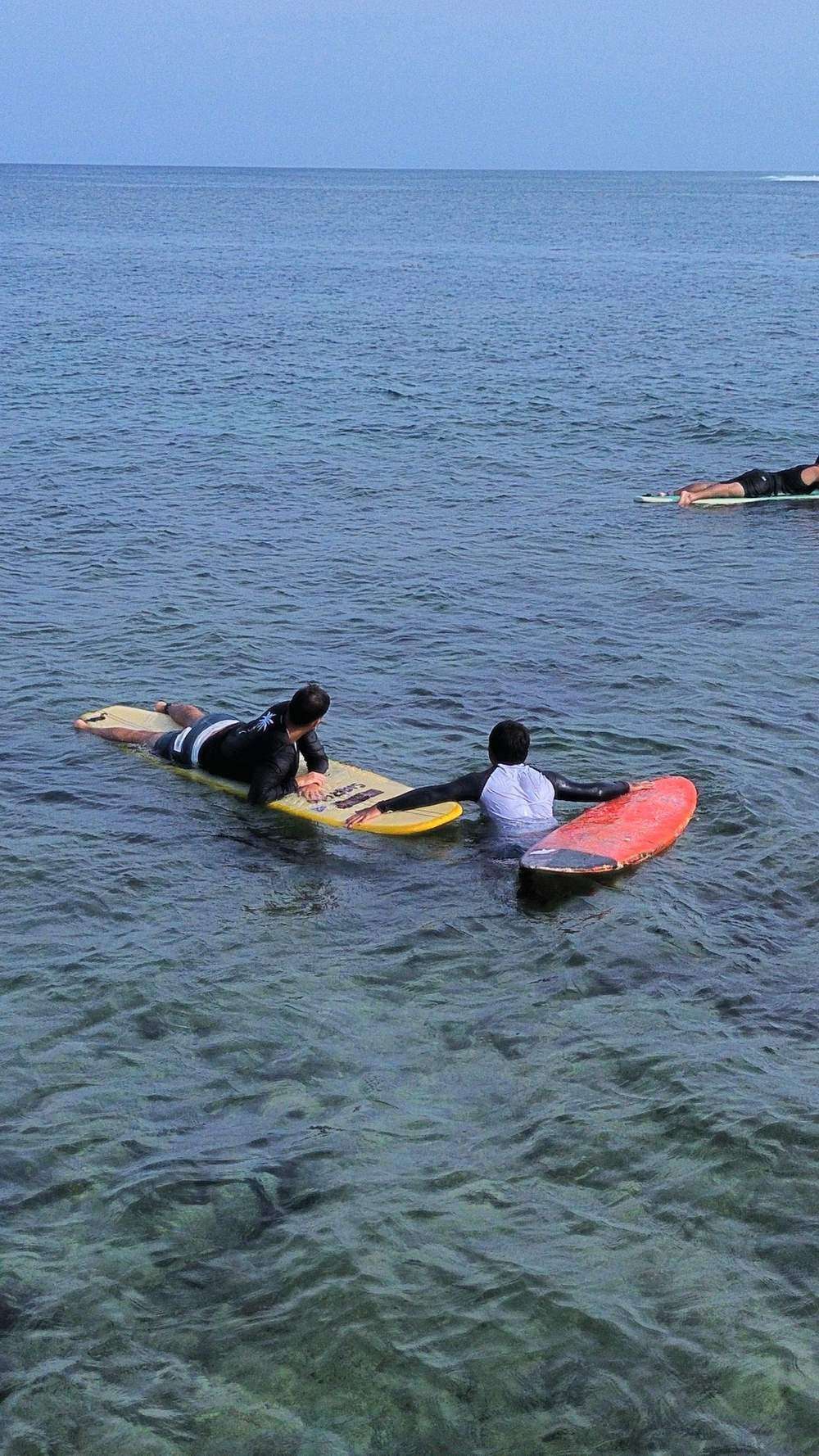
Beginners in Siargao surf at four spots: Jacking Horse, Daku, Ocean 9 and Guiwan. Jacking Horse is the default for a first lesson, because you walk to it through the Cloud 9 gate and the wave there is soft. Daku is reached by boat, Ocean 9 works mostly from October to March, and Guiwan is kept for people who already have a few lessons behind them.
Cloud 9 is not on the list. Since July 2025 a rule there bans beginner lessons, and in any case the wave is hollow and breaks over shallow reef, so it is a poor place to learn. Further down you will find exactly what the rule says, what is known about who published it, and what we could not confirm. First, what makes a wave a beginner wave, and what each spot offers in practice.
What makes a wave a beginner wave
It starts with the way the wave breaks. According to Wikipedia (Breaking wave), a spilling wave forms when the sea floor slopes gradually: the top edge loses stability, whitewater tumbles down the face, and the energy is released over a long stretch. A plunging wave forms over a steep floor or a sudden change in depth, such as a reef, and releases most of its energy at once, in a relatively violent impact. The tube that experienced surfers look for comes from exactly that kind of wave.
The first type suits beginners. The whitewater travels slowly, you have time to stand up, and if you fall the wave does not slam you downward.
There is a caveat. The type of break is usually estimated with the Iribarren number, a measure that combines the slope of the bottom with the height and length of the wave. A 2020 study by Moragues, Clavero and Losada tested it in a wave flume, with regular waves on a smooth 1:10 slope, and found that apart from spilling and early plunging waves, the number does not predict the break type on its own. The formula is a rough guide, and the person who looks at the sea in the morning makes the call.
One more thing worth knowing in advance: every wave around General Luna breaks over reef, even at a spot that feels like a sandy beach. A reef does not turn every wave into a plunging one. At Jacking Horse and Daku the wave breaks softly, and on Daku The Surf Atlas writes that the reef is deep. But the tide decides how much water sits over the reef, and the current changes with it.
Jacking Horse: the spot where beginners learn
A soft right over reef that feels like a beach break. You walk in through the Cloud 9 gate, with no boat and no drive. It works all year, but from June to September the waves are very small. The spot faces roughly north-east.
The Surf Atlas (updated February 2025) describes it as a “mushy” wave that mostly stays at chest height or below, and mentions a current that makes paddling harder. In our experience the side current is felt mostly at high tide and around the full moon, and on those days the coach decides whether to stay or move to another spot. On tide the sources disagree: according to The Surf Atlas the reef is too exposed at low tide, while Mondo says the wave works best at low and mid tide. So we do not give a fixed tide window here, and the coach checks the sea that same morning.
It suits anyone starting from zero, kids and adults alike, and it is where the first lesson usually takes place, with the coach next to you in the water, pushing the board into the wave at the right moment. More details on the Jacking Horse spot page.
Daku: a small island and a slow wave
Daku is an island off General Luna, about 15 minutes by boat. There is a village on it: according to the 2020 census data as shown on PhilAtlas, the barangay of Daku (the smallest administrative unit in the Philippines) had 507 residents. According to Mondo’s spot guide you can only reach the wave by boat, the bottom is coral reef, and it works best at mid to high tide.
It is a slow right with a soft take-off. It works mainly in the swell season and faces roughly north to north-north-east. The Surf Atlas is stricter than we are: it says Daku suits most levels except complete beginners. It also says the main problem there is crowds, so it is worth going out early, while Mondo says the spot is usually empty. For us Daku suits intermediate surfers, and beginners go there only with a coach who stays next to them in the water the whole time, and usually not in the first lesson. Details on the Daku page.
Ocean 9: a sheltered bay and small waves
Ocean 9 is a bay in front of a resort near General Luna, with small lefts and rights. It works mostly from October to March. The bay is sheltered and faces north, so on days when the open sea is too big for beginners, you can sometimes learn there in peace.
We should be honest about what is not known. We did not find an independent spot guide that describes the bottom and the wave, so everything here comes from our own time in the water: the bottom is reef like everywhere else, the waves are small, and the way in goes through the resort. The resort charges an entry fee, so ask the coach for the current amount when you book a lesson. Details on the Ocean 9 page.
Guiwan: for surfers who already know their way around a board
Guiwan is on the south side of the island, a 15 to 20 minute drive, and it faces south. Shallow lefts and rights with hidden rocks. It works in winter, when the wind is north-easterly, and it suits beginners with a bit of experience and intermediate surfers.
The hidden rocks are the reason it is not a place to start. You come here after a few lessons in small waves, once you can paddle into a wave on time and stand up without thinking about every move. More on the Guiwan page.
The four spots side by side
| Spot | The wave | Access | Season | For whom |
|---|---|---|---|---|
| Jacking Horse | Soft right over reef, feels like a beach break | On foot through the Cloud 9 gate | All year, very small June to September | Complete beginners |
| Daku | Slow right with a soft take-off | About 15 minutes by boat | Mainly in the swell season | Beginners with a coach, and intermediates |
| Ocean 9 | Small lefts and rights in a sheltered bay | Through a resort | October to March | Beginners |
| Guiwan | Shallow lefts and rights, hidden rocks | 15 to 20 minutes by road | Winter, north-easterly wind | Beginners with some experience, and intermediates |
The Cloud 9 rule: what it says and who published it
On 16 July 2025 SURFER, in an article by Dashel Pierson, ran the wording of two rules. The first is quoted here as published, including the mistake (“and” instead of “are”): “Beginner surf lessons and NOT ALLOWED at Cloud 9 surf spot.” The second reads: “Surf shops are NOT ALLOWED to rent out surfboards to beginner surfers without instructor.” In other words, beginner lessons are not allowed at Cloud 9, and shops may not rent boards to beginners who come without an instructor.
The rule does not ban everyone. According to the announcement, surfers who know lineup etiquette, can catch waves on their own and do not endanger others are welcome at Cloud 9. It applies to Cloud 9 only, not to other spots on the island.
So who published it? SURFER attributes the announcement to Bryan, a local surf photographer who posted it on Instagram. Bryan explained the rule with “the new local government in place and the emergence of dedicated surf leaders within our community”. Wavelength reported on 15 July 2025 that the rules were released “over the weekend” in an Instagram post. It did not say who issued them and did not mention enforcement or any penalty. According to the same report, the reactions to the post were mostly positive, and some people asked for a rule like this to apply worldwide.
One local blog, siargao.ph (29 August 2025), writes that a dormant municipal ordinance was revived and that every peak now has a steward who enforces the rules. It gives no ordinance number, enforcing body or fine, and we found no official source confirming it. So we do not know whether there is a fine, who enforces the rule, or whether it is a decision of the municipality, of a surfers’ association or of the community. Either way, we do not take beginners there.
The physical reason does not depend on who wrote the rule. According to Mondo’s spot guide, the wave at Cloud 9 breaks with power over shallow live coral, it is hollow and fast, and it “can break boards and bones”. Mondo rates it a spot for intermediate and advanced surfers, and notes that at the peak of the season, between September and November, it is crowded too.
Our opinion, including the part that costs us money
Cloud 9 is the most famous wave in Siargao, and commercially a beginner lesson there would be an easy product to sell. Even so, we agree with the rule: a first lesson in a hollow wave over shallow reef is a bad idea.
Our advice on the boat also costs us money: for a first lesson a boat is usually not worth it. Jacking Horse, which you walk to, is the better start. Daku is for the second or third lesson, when you can make use of a longer, slower wave. On days with good waves, a boat trip to a spot off the coast costs an extra ₱300 with us (see the prices page). If you did not pay it for your first lesson, you missed nothing.
How the coach picks a spot in the morning
There is no fixed meeting point. The coach picks the spot by your level and by the state of the sea that morning, and tells you where to meet. On the ocean side, three things decide it:
- Tide: it decides how much reef is exposed and how much current there is. At Jacking Horse, for example, a side current is noticeable at high tide and around the full moon.
- Wind: in winter, when the wind is north-easterly, Guiwan is one of the spots that works.
- Swell direction: every spot has a swell window, the range of directions it picks up waves from, and each one faces a different way: Jacking Horse north-east, Daku north to north-north-east, Ocean 9 north, Guiwan south.
You can check this data yourself. The forecast on this site shows five days ahead for each spot, with wave height, wind and tide, and it is updated several times a day. It is calculated from Copernicus and NOAA models and is meant for planning only. It is not an official forecast, and for warnings follow PAGASA and local advice. How to read it is explained in the guide to reading the forecast.
Lineup etiquette for beginners
According to Surfer Today, the surfer closest to the peak, the point where the wave starts to break, has priority over everyone else. A surfer farther out has priority over one closer in, and priority is set the moment you start to stand up. If the surfer with priority misses the wave, priority passes to the next surfer. A surfer who takes a wave without priority, what surfers call a drop-in, should kick out and give the wave up.
It is easy to drop in by accident when you look at the board instead of the sea. What helps: look around before you paddle, do not sit on the peak or compete for it, and listen to the coach, who tells you when to paddle and when to let it go. In a lesson this is simpler, because the coach is next to you and sets the timing. With experienced surfers we work on exactly these things: choosing a wave, where to sit in the lineup, and how to share waves.
If you are planning a first lesson, there is a separate guide to the first lesson, with what to bring and what happens on the sand before you enter the water. Details of our lessons are on the lessons page.
About the authors
Francis, Michael and Glenn, the local coaching team of Surfing Sirago in General Luna. Michael (26) was born and raised in Siargao and is an instructor certified by the Siargao Island Surfers Association (SISA). Glenn (38) has surfed since he was 17 and holds a SISA level 2 licence. For questions and to book a lesson, send Michael a WhatsApp message: +63 950 304 3184.
Frequently asked questions
Can beginners surf at Cloud 9?
Under the rule published in July 2025, beginner lessons there are not allowed, and shops may not rent boards to beginners without an instructor. Experienced surfers are still welcome, as long as they know lineup etiquette, catch waves on their own and do not endanger others.
Who issued the Cloud 9 rule, and is there a fine?
It is unclear. SURFER attributes the announcement to a local surf photographer who posted on Instagram, and one local blog mentions an old municipal ordinance. We found no ordinance number or fine.
Which spot is best for a first lesson?
Jacking Horse. You walk to it through the Cloud 9 gate, the wave is a soft right, and it works all year, though it is very small between June and September.
Do you need a boat to learn to surf in Siargao?
No. You start at a spot you can walk to, and the boat to Daku usually comes with the second or third lesson.
When does Ocean 9 work?
Mostly from October to March. It is a sheltered bay that faces north, with small lefts and rights.
Why is Guiwan not for complete beginners?
The water there is shallow and there are hidden rocks. Someone who has already stood up and has some control of the board can surf there with a coach.
- SURFER (via Yahoo Sports), the Cloud 9 rule, 16 July 2025
- Wavelength, report on the new rules, 15 July 2025
- siargao.ph, local blog, 29 August 2025
- Wikipedia, Breaking wave
- Moragues, Clavero, Losada, J. Mar. Sci. Eng. 2020
- Mondo, Cloud 9 spot guide
- Mondo, Daku Island spot guide
- Mondo, Jacking Horse spot guide
- The Surf Atlas, surfing in Siargao
- PhilAtlas, Daku census data
- Surfer Today, wave priority